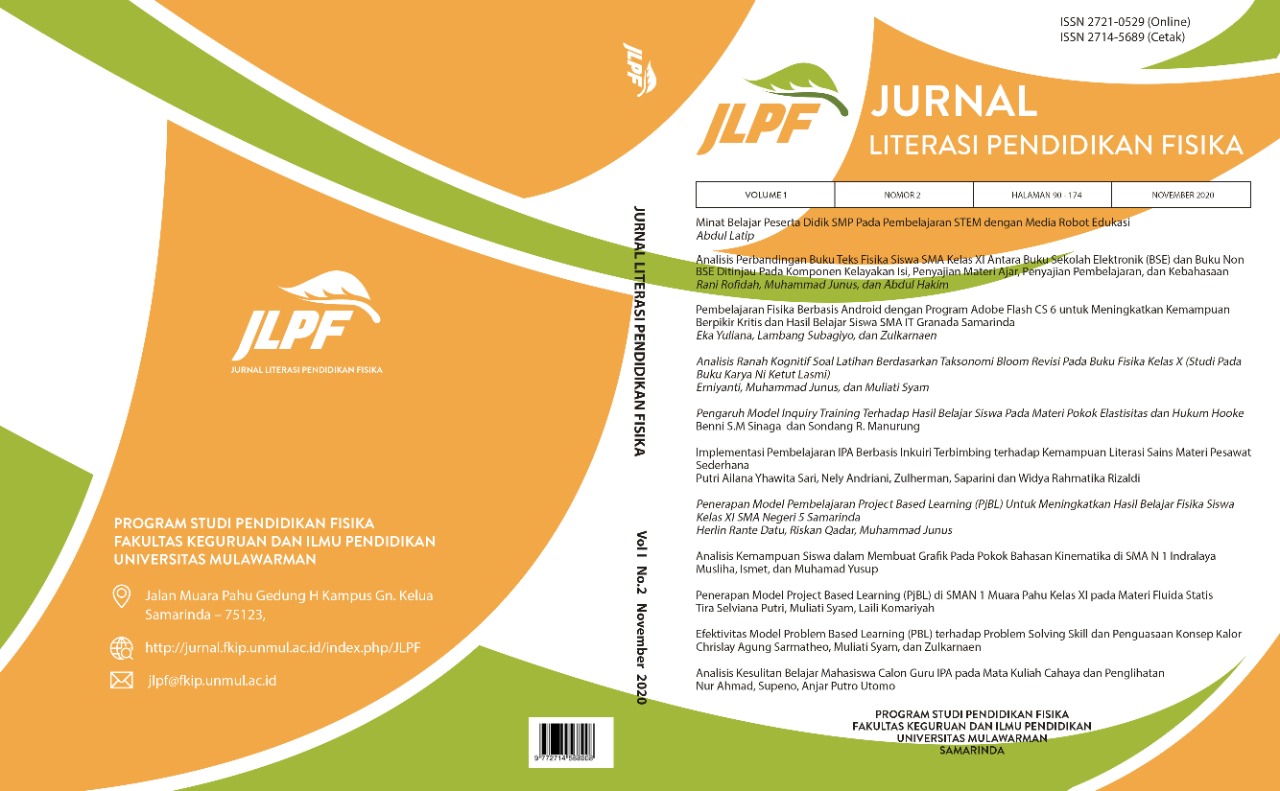
Pengaruh Model Inquiry Training terhadap Hasil Belajar Siswa pada Materi Pokok Elastisitas dan Hukum Hooke
DOI:
https://doi.org/10.30872/jlpf.v1i02.335Keywords:
model inquiry training, hasil belajar, aktivitasAbstract
Penelitian ini bertujuan untuk mengetahui pengaruh model pembelajaran inquiry training terhadap hasil belajar siswa pada materi elastisitas dan hukum hooke. Jenis penelitian yaitu quasi experiment. Populasi dalam penelitian adalah seluruh siswa kelas XI Semester I SMA Negeri 1 Parbuluan yang terdiri dari empat kelas MIA. Sampel penelitian yaitu kelas XI MIA-1 sebagai kelas eksperimen dan kelas XI MIA-2 sebagai kelas kontrol, masing-masing berjumlah 35 orang yang ditentukan dengan cara cluster random sampling. Instrumen yang digunakan adalah tes hasil belajar. Berdasarkan hasil penelitian diperoleh nilai rata-rata pretes kelas eksperimen 32,00 dan nilai rata-rata pretes kelas kontrol 28,37. Nilai postes di kelas eksperimen memperoleh nilai rata-rata 64,57 dan kelas kontrol 55,62. Berdasarkan hasil analisis uji t disimpulkan bahwa ada perbedaan akibat pengaruh model pembelajaran inquiry training terhadap hasil belajar siswa pada materi elastisitas dan hukum hooke di kelas XI semester I SMA Negeri 1 Parbuluan, dari T.P. 2019/2020.
Downloads
Downloads
Published
Issue
Section
License
Jurnal Literasi Pendidikan Fisika (JLPF) is an Open Access Journal. JLPF allows the author(s) to hold the copyright and retain the publishing rights. Authors who publish in this journal agree to the following terms:

Jurnal Literasi Pendidikan Fisika (JLPF), published by the Physics Education Program, Universitas Mulawarman is licensed under a Creative Commons Attribution 4.0 International License (CC BY 4.0). This permits anyone to:
1. Share - copy and redistribute the material in any medium or format
2. Adapt - remix, transform, and build upon the material for any purpose, even commercially.
Under the following terms:
1. Attribution - You must give appropriate credit, provide a link to the license, and indicate if changes were made. You may do so in any reasonable manner, but not in any way that suggests the licensor endorses you or your use.
2. No additional restrictions — You may not apply legal terms or technological measures that legally restrict others from doing anything the license permits.



.png)