About the Journal
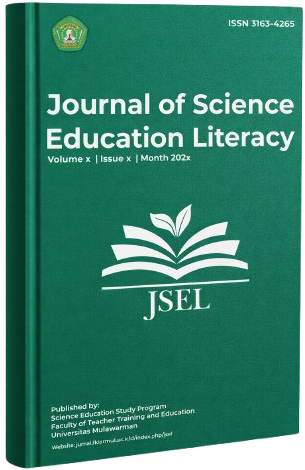
The Journal of Science Education Literacy (JSEL) is a peer-reviewed electronic journal managed by the Science Education Study Program, Faculty of Teacher Training and Education at Universitas Mulawarman. We are dedicated to the global advancement of science education by providing a platform for full-length research and comprehensive literature reviews. Our publication serves the academic community across all educational levels, including primary, secondary, and higher education.
JSEL is committed to bridging the gap between theoretical science and practical educational applications. Our focus encompasses several key pillars:
- Innovation in science education
- Development of context-based science teaching materials
- Scientific research and review in science, physics, biology, chemistry, and environment.
- Science literacy for the twenty-first century
- Evaluation of educational standards in science
Review Process & Ethical Standards
To ensure the highest quality of published work, JSEL employs a rigorous double-blind review system involving at least two expert reviewers. We maintain a strict anti-plagiarism policy with a maximum similarity threshold of 20 percent, utilizing industry-standard tools such as Turnitin or iThenticate to verify the integrity of every submission.
In alignment with the Budapest Open Access Initiative, JSEL provides immediate and unrestricted open access to all its content. Under the Creative Commons Attribution 4.0 International License (CC BY 4.0), authors retain their copyright while allowing others to share and adapt their work with proper acknowledgment.
No Publication Fees
At this time, JSEL does not charge any author fees for article submission or publication. All operational costs are supported by the Science Education Study Program at Universitas Mulawarman, allowing authors to publish high-quality research without any financial barriers.
Journal Information
| Journal Title | Journal of Science Education Literacy |
| Initials | JSEL |
| DOI Prefix | https://doi.org/10.30872 |
| ISSN (Online) | 3163-4265 |
| Publication Frequency | Two issues per year (May & October) |
| Publisher | Science Education Study Program, Universitas Mulawarman |
Contact us: jurnal.pendidikan.ipa@fkip.unmul.ac.id
 Editorial Team
  Reviewers
  Focus and Scope
  Peer Review Process
  Open Access Policy
  Publication Ethics
  Author Guidelines
  Plagiarism Screening
  Copyright Notice
  Author Fees
  AI Declare