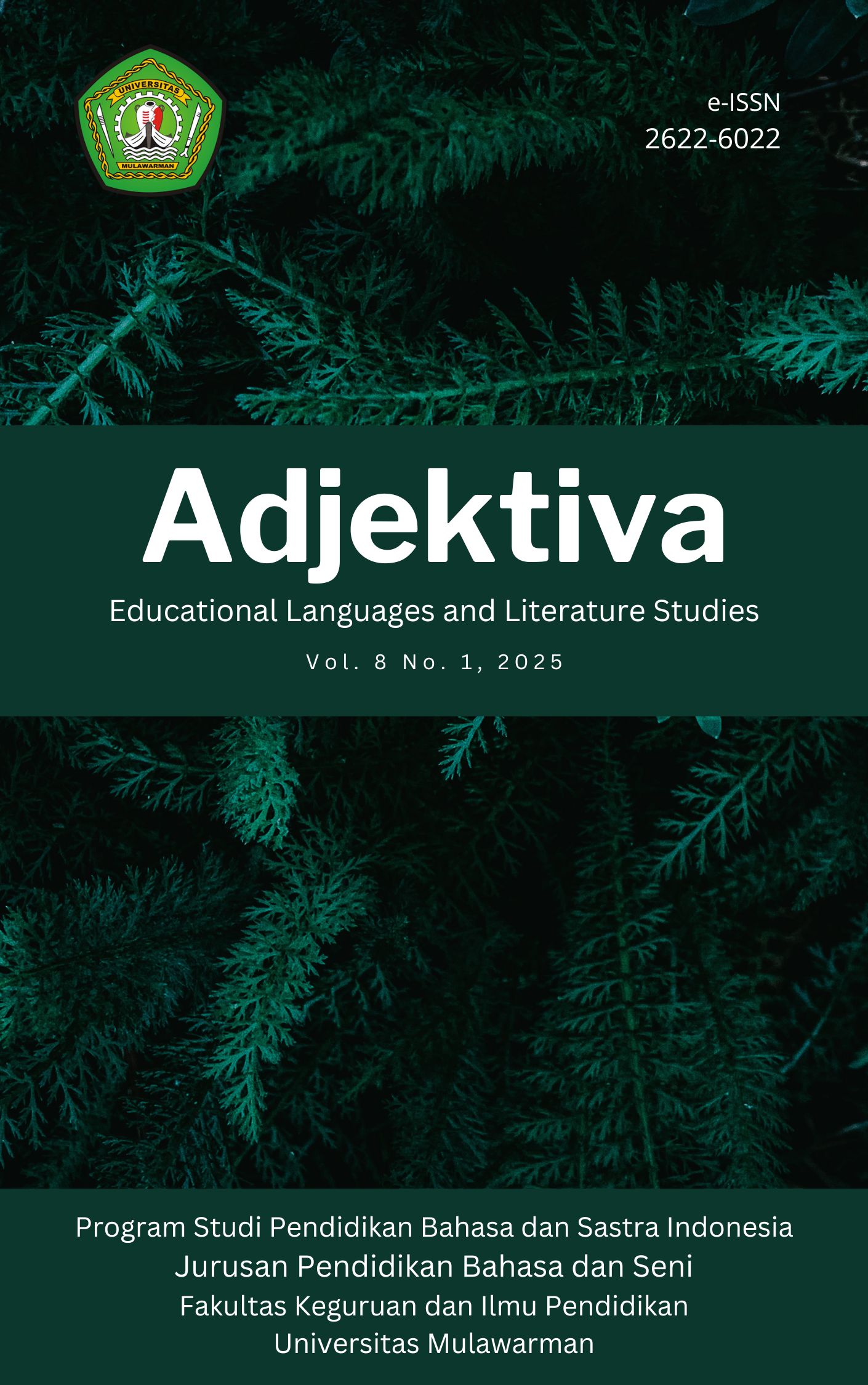
Analisis Penggunaan Frame Markers, Transitions, dan Sequence Markers dalam Penulisan Ilmiah Mahasiswa
DOI:
https://doi.org/10.30872/adjektiva.v8i1.5181Keywords:
metadiscourse, academic writing, rhetorical structure, undergraduate studentsAbstract
This study investigates the use of interactive metadiscourse in the background sections of academic papers written by 38 undergraduate students enrolled in the General Compulsory Indonesian Language Course at Universitas Mulawarman in 2025. Grounded in Hyland’s (2005) metadiscourse framework, the research focuses on three key subcategories: frame markers, transitions, and sequence markers. A qualitative descriptive method was employed through document analysis to examine how students deploy these rhetorical strategies to construct coherence and guide readers through their arguments. Each student paper was manually analyzed for the presence and frequency of metadiscourse markers, with findings triangulated by course instructors for validation. The results reveal that most students utilized more than one type of interactive marker in their writing, with 29 students using frame markers and 28 students applying transitions. However, only one student incorporated sequence markers, indicating a limited awareness of this rhetorical device. The intensity of usage varied across individuals, ranging from 6 to 20 occurrences, suggesting differing levels of rhetorical competence and text organization. Students who used metadiscourse more frequently demonstrated stronger cohesion, while those with lower usage tended to produce less structured and more descriptive texts. This study highlights the importance of explicit instruction in academic writing, particularly in metadiscourse, to support students in developing effective rhetorical strategies. The findings offer practical implications for language instruction at the tertiary level and contribute to the broader understanding of how metadiscourse functions in the early stages of academic literacy development in non-English speaking contexts.
References
Akoto, E. (2020). Metadiscourse in master’s and PhD theses: A corpus-based analysis. Journal of Second Language Writing, 50, 100810. https://doi.org/10.1016/j.jslw.2020.100810
Alghamdi, R., & Paltridge, B. (2025). Metadiscourse studies in written L2 English in the MENA region: A systematic review. Journal of English for Academic Purposes, 62, 101168. https://doi.org/10.1016/j.jeap.2025.101168
Aktif, A., & Bahous, R. (2023). Metadiscourse in advanced academic writing: A corpus-based study across disciplines. Journal of English for Academic Purposes, 63, 101210. https://doi.org/10.1016/j.jeap.2023.101210
Heng, C. S., & Tan, H. (2022). Teaching metadiscourse to improve student academic writing: An intervention study. English for Specific Purposes, 67, 35–47. https://doi.org/10.1016/j.esp.2022.01.002
Hinkel, E. (2023). Teaching academic writing: The role of metadiscourse in EFL composition. Journal of English for Academic Purposes, 61, 101170. https://doi.org/10.1016/j.jeap.2023.101170
Hyland, K. (2005). Metadiscourse: Exploring interaction in writing. London: Continuum.
Hyland, K., & Jiang, F. (2022). The use of stance and engagement features in writing: A diachronic perspective. Journal of Pragmatics, 199, 63–74. https://doi.org/10.1016/j.pragma.2022.03.003
Hyland, K., & Tse, P. (2004). Metadiscourse in L2 postgraduate writing: A Hong Kong study. Journal of Second Language Writing, 13(4), 287–302. https://doi.org/10.1016/j.jslw.2004.07.001
Nurhaidah, N., & Calvinna, R. (2023). Analisis sifat monologis dan struktur interaktif dalam esai mahasiswa. Jurnal Ilmu Bahasa dan Sastra, 18(1), 55–69.
Pearson, W. S., & Abdollahzadeh, E. (2023). Metadiscourse in academic writing: A systematic review. Discourse Studies, 25(4), 415–438. https://doi.org/10.1177/14614456231156478
Pratabjai, P. T., Amnuai, W., & Tayjasanant, C. (2025). Investigating persuasive metadiscoursal strategies in L2 English research article discussions. ESP Today, 13(1), 24–43. [Forthcoming Issue]
Saidi, M., & Karami, N. (2021). Interactional metadiscourse markers in applied linguistics reply articles. Language Teaching Research Quarterly, 22, 64–77. https://doi.org/10.32038/ltrq.2021.22.05
Yang, J. (2025). Metadiscourse in the research abstracts of an interdisciplinary field: A case study of computational linguistics. Humanities and Social Sciences Communications, 12, Article 448. https://doi.org/10.1057/s41599-025-04582-9
Yanti, S. N., & Sofyan, D. (2022). Penggunaan metadiscourse dalam teks argumentatif mahasiswa program studi Bahasa Inggris. Jurnal Pendidikan Bahasa, 17(2), 113–124.
Downloads
Published
Issue
Section
License
Copyright (c) 2025 Kukuh Elyana

This work is licensed under a Creative Commons Attribution-ShareAlike 4.0 International License.